
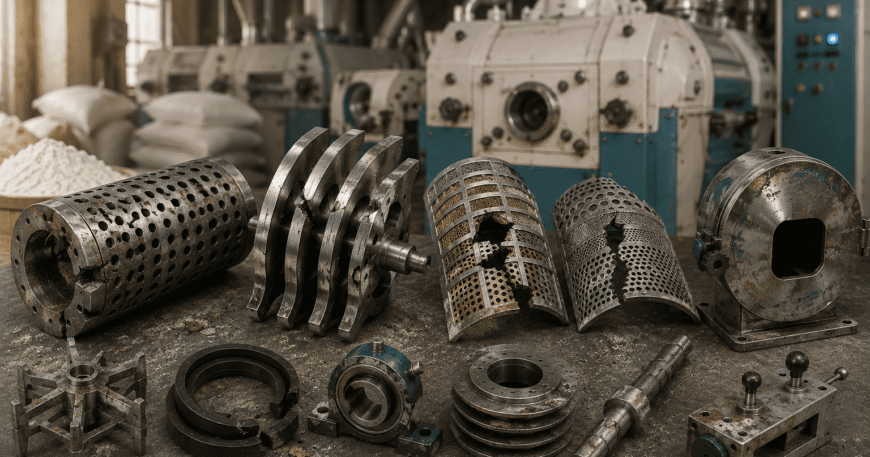
The efficiency of any flour mill depends on the quality of its machinery and the components installed within it. Modern flour milling machines are designed to operate continuously under demanding industrial conditions, processing large quantities of grain while maintaining consistent flour quality. Every component—from the flour mill drum and liner cutter to bearings, shafts, rings, and couplings—plays a critical role in ensuring smooth and reliable operation.
Unfortunately, many flour mill owners try to reduce costs by purchasing low-quality or non-genuine spare parts. While these parts may appear to be a cost-effective solution initially, they often result in expensive machine failures, reduced production efficiency, poor flour quality, increased maintenance costs, and frequent downtime. Inferior materials, inaccurate dimensions, and poor manufacturing standards can significantly affect the performance of the entire milling system.
Choosing premium-quality flour mill parts is not simply about replacing worn components—it is an investment in long-term productivity, machine reliability, and business profitability. High-quality spare parts improve operational efficiency, reduce maintenance requirements, increase machine lifespan, and ensure consistent production even during continuous industrial use.
At Gurudev Engineering, we manufacture precision-engineered flour mill machinery parts using advanced CNC machining, premium-grade raw materials, and strict quality control procedures. Our components are designed to withstand heavy workloads while delivering reliable performance and long service life.
In this comprehensive guide, we’ll explore the most common problems caused by low-quality flour mill parts, explain their impact on production efficiency, and discuss how investing in premium engineering solutions can help protect your machinery and business.
Why Spare Part Quality Matters
Every flour mill is a system of interconnected mechanical components. When one part is poorly manufactured or wears out prematurely, it places additional stress on surrounding components, increasing the likelihood of machine failure.
Low-quality spare parts often have:
- Poor dimensional accuracy
- Inferior raw materials
- Low wear resistance
- Weak structural strength
- Rough surface finish
- Short service life
These issues can quickly affect the overall efficiency and reliability of the milling process.
1. Frequent Machine Breakdowns
One of the most common problems associated with inferior spare parts is unexpected machine failure.
Low-quality components wear out much faster than precision-engineered parts. As a result, machines require frequent repairs and emergency maintenance, interrupting production schedules and increasing operating costs.
Impact
- Production delays
- Lost working hours
- Emergency repair expenses
- Reduced customer satisfaction
- Lower overall productivity
Reliable components significantly reduce the risk of unexpected breakdowns.
2. Poor Grinding Performance
The quality of flour depends on the precision of grinding components.
Low-quality machine parts often fail to maintain proper alignment, causing inconsistent grain processing and uneven flour texture.
Common issues include:
- Uneven particle size
- Reduced grinding efficiency
- Lower flour quality
- Product wastage
- Customer complaints
Premium-quality components ensure consistent grinding performance throughout their service life.
3. Increased Machine Vibration
Improperly manufactured machine parts frequently have inaccurate dimensions or poor balancing.
This causes excessive vibration during operation, which leads to:
- Loose fasteners
- Bearing damage
- Shaft wear
- Higher noise levels
- Reduced machine stability
Persistent vibration shortens the lifespan of the entire milling system.
4. Higher Maintenance Costs
Cheap spare parts usually require replacement much more frequently than genuine components.
This increases:
- Repair costs
- Spare parts inventory
- Labor expenses
- Production interruptions
- Maintenance frequency
Although premium parts may cost more initially, they significantly reduce long-term maintenance expenses.
5. Reduced Machine Lifespan
Low-quality components create additional stress on adjacent machine parts.
For example:
- Worn bearings damage shafts.
- Misaligned rings increase vibration.
- Poor couplings affect motors.
- Damaged drums reduce grinding efficiency.
Over time, these problems shorten the lifespan of expensive machinery.
6. Higher Energy Consumption
Machines operating with worn or poorly manufactured components require more power to perform the same work.
Reasons include:
- Increased friction
- Improper alignment
- Excessive vibration
- Higher mechanical resistance
This results in:
- Increased electricity bills
- Lower operational efficiency
- Reduced profitability
Precision-engineered components help maintain energy-efficient operation.
7. Frequent Bearing Failure
Bearings are among the most important moving components in a flour mill.
Low-quality bearings often suffer from:
- Poor lubrication retention
- Inferior steel quality
- Weak heat resistance
- Premature wear
Damaged bearings increase vibration and may eventually cause complete machine failure.
8. Shaft Damage
Shafts transmit power throughout the milling system.
Poor-quality shafts may experience:
- Cracks
- Bending
- Excessive wear
- Misalignment
- Fatigue failure
High-strength precision shafts provide reliable performance even under heavy industrial loads.
9. Reduced Flour Quality
Customers expect flour with consistent texture and particle size.
Low-quality machine parts often produce:
- Uneven grinding
- Burnt flour
- Product contamination
- Inconsistent output
- Reduced customer confidence
Maintaining high-quality components ensures consistent product quality and protects brand reputation.
10. Increased Production Downtime
Every production interruption affects profitability.
Low-quality spare parts contribute to:
- Frequent servicing
- Unexpected repairs
- Longer maintenance periods
- Reduced machine availability
Reliable engineering components help maintain continuous production schedules.
Warning Signs of Poor-Quality Flour Mill Parts
Operators should monitor machines for early warning signs.
Common symptoms include:
- Unusual machine noise
- Excessive vibration
- Increased motor temperature
- Grinding inconsistency
- Frequent lubrication requirements
- Loose fittings
- Visible corrosion
- Rapid component wear
Identifying these signs early helps prevent major equipment failures.
How High-Quality Parts Improve Performance
Premium-quality flour mill components offer several advantages.
Precision Engineering
Accurate dimensions improve fitting and reduce mechanical stress.
Superior Raw Materials
High-grade metals increase strength and wear resistance.
Better Surface Finish
Smooth surfaces reduce friction and improve efficiency.
Longer Service Life
Durable materials reduce replacement frequency.
Reliable Performance
Machines operate smoothly with fewer interruptions.
Lower Operating Costs
Reduced maintenance and energy consumption improve profitability.
Choosing the Right Flour Mill Parts Manufacturer
Selecting a trusted manufacturer is essential for maintaining machine performance.
Look for manufacturers offering:
- CNC machining
- Premium raw materials
- Strict quality inspection
- Experienced engineers
- Customized manufacturing
- Competitive pricing
- Reliable delivery
- Technical support
Partnering with a reputable manufacturer ensures consistent product quality.
Why Choose Gurudev Engineering?
At Gurudev Engineering, we manufacture premium-quality flour mill machinery parts designed for continuous industrial operation.
Our advantages include:
- Advanced CNC manufacturing
- Skilled engineering professionals
- Premium-grade materials
- Precision machining
- Comprehensive quality testing
- Timely delivery
- Customized engineering solutions
- Excellent customer service
Our products are trusted by flour mill manufacturers and industrial businesses throughout India.
Our Commitment to Quality
Every product undergoes multiple quality inspections before dispatch.
Our process includes:
- Raw material testing
- Dimensional verification
- Precision machining inspection
- Surface finish testing
- Performance evaluation
- Final quality approval
This ensures customers receive durable, reliable, and precision-engineered components.
Conclusion
Using low-quality flour mill parts may appear to reduce costs initially, but it often leads to expensive repairs, production delays, poor flour quality, increased energy consumption, and shorter machine life. Investing in premium-quality components is the most effective way to improve production efficiency, reduce maintenance costs, and protect valuable machinery.
At Gurudev Engineering, we are committed to manufacturing high-performance flour mill machinery parts that meet the highest standards of precision, durability, and engineering excellence. Whether you need replacement components or customized manufacturing solutions, our products are designed to keep your milling operations running smoothly and efficiently.
Choose Gurudev Engineering for reliable flour mill parts that deliver superior performance, long service life, and maximum value for your business.