
For generations, Indian families have used traditional methods to grind grains and prepare flour. Grinding wheat and other grains was once a regular household activity that required considerable time and manual effort.
Today, the gharghanti machine has made home flour grinding much more convenient.
A modern domestic flour mill allows families to process suitable grains at home using an electric motor and mechanical grinding system. Depending on the machine, users can grind wheat, bajra, jowar, maize, rice and other compatible grains.
But how different is a modern gharghanti from traditional flour grinding?
And why are more households interested in having a home flour mill?
Let’s compare both methods in detail.
What Is Traditional Flour Grinding?
Traditional flour grinding refers to older methods of processing grains using manual or conventional grinding equipment.
Historically, grains were processed using tools such as hand-operated grinding stones and other traditional systems.
These methods can produce flour, but they generally require more manual involvement.
The process can include:
- Cleaning the grain
- Preparing the grain
- Manually grinding it
- Collecting the flour
- Cleaning the grinding equipment
For small quantities, traditional methods can still be useful.
However, they may not provide the same convenience as a modern electric flour mill.
What Is a Modern Gharghanti?
A gharghanti is a domestic flour mill designed for household grain grinding.
Modern gharghanti machines generally use an electric motor to drive a grinding mechanism.
Depending on the model, the machine may include:
- Motor
- Grinding chamber
- Hopper
- Grinding components
- Sieving arrangement
- Flour outlet
- Cabinet
- Control system
The exact design varies between manufacturers and models.
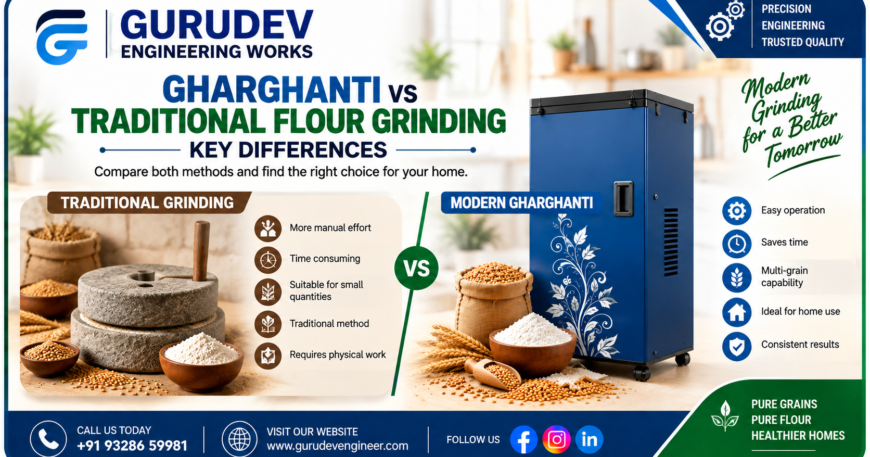
Gharghanti vs Traditional Grinding
Let’s compare the two methods based on important factors.
1. Manual Effort
Traditional grinding can require significant manual effort.
The user needs to operate or monitor the grinding process more directly.
A modern gharghanti reduces this manual work because the electric motor powers the grinding system.
This makes regular household flour grinding more convenient.
2. Time and Convenience
One of the biggest differences is convenience.
Traditional grinding can take more time and effort, especially when larger quantities of grain need to be processed.
A modern home flour mill is designed to make the process easier.
The user can prepare the grain, operate the machine according to the manufacturer’s instructions, and collect the processed flour.
This can be particularly useful for households that grind flour regularly.
3. Electric Operation
Modern gharghanti machines use an electric motor.
This means the user does not need to manually operate the grinding mechanism.
The motor drives the internal grinding components while the machine is operating.
However, electricity requirements vary according to the machine.
Before purchasing a gharghanti, check:
- Motor capacity
- Voltage requirements
- Recommended operating conditions
- Electrical safety features
4. Grain Flexibility
Traditional grinding systems can be designed for specific applications.
Modern multi-grain gharghanti machines may support several suitable grains depending on their design.
These can include:
- Wheat
- Bajra
- Jowar
- Maize
- Rice
- Corn
However, users should never assume that every gharghanti can process every grain.
Always check the manufacturer’s specifications before using a new grain.
5. Ease of Operation
A modern domestic flour mill is generally designed with household operation in mind.
Many machines have straightforward controls and a dedicated grain feeding area.
This can make the process easier for people who regularly prepare flour at home.
Traditional methods usually require more direct physical involvement.
6. Consistency of Operation
The performance of a modern gharghanti depends on several factors, including:
- Grain condition
- Grinding setting
- Machine design
- Motor
- Grinding components
- Feeding method
When the machine is used according to its specifications, it can provide a more controlled grinding process.
Traditional methods depend more heavily on manual operation.
7. Space Requirements
Traditional grinding equipment can vary significantly in size.
Modern gharghanti machines are commonly designed as compact cabinet-style appliances for domestic environments.
Before purchasing, users should still check the actual dimensions.
Consider:
- Height
- Width
- Depth
- Operating area
- Cleaning space
- Ventilation
8. Cleaning Requirements
Both traditional and modern grinding systems require cleaning.
A gharghanti may require regular removal of flour residue from accessible areas.
Modern machines should be cleaned according to the manufacturer’s instructions.
Avoid using excessive water around electrical components.
Traditional grinding equipment may also require cleaning after each use, particularly when different grains are processed.
9. Maintenance
A modern flour mill contains mechanical and electrical components.
Regular maintenance may include:
- Cleaning
- Visual inspection
- Checking unusual noise
- Checking vibration
- Inspecting wear
- Following the manufacturer’s service schedule
Traditional equipment may have fewer electrical components, but physical wear can still occur.
Every grinding system requires appropriate care for reliable use.
10. Suitable for Modern Households
Today’s households often have limited time for manual food preparation.
A modern atta chakki for home can reduce the effort involved in regular grain grinding.
It can be particularly useful for families that:
- Regularly consume wheat flour
- Use multiple grains
- Prefer home grinding
- Want convenient operation
- Have suitable space for a machine
Does a Gharghanti Replace Traditional Grinding Completely?
Not necessarily.
Both methods have their own applications.
Traditional grinding can still be appropriate for people who prefer conventional methods or process small quantities manually.
A gharghanti is designed primarily for convenience and regular household operation.
The choice depends on personal requirements, available space, preferred method and frequency of grinding.
Important Things to Consider Before Switching to a Gharghanti
If you are considering a modern home flour mill, check:
Motor Capacity
Choose a machine suitable for your expected usage.
Grain Compatibility
Confirm which grains can be processed.
Machine Dimensions
Make sure it fits your available space.
Grinding System
Understand how the machine processes grain.
Cleaning
Check how easily accessible areas can be cleaned.
Spare Parts
Ask about replacement component availability.
Service Support
Check whether the manufacturer provides technical assistance.
Why Modern Gharghanti Machines Are Useful for Indian Homes
Indian households use a wide variety of grains and flour-based foods.
Depending on the region and family preferences, people may use wheat, bajra, jowar, maize and rice.
A suitable multi-grain gharghanti can provide flexibility while keeping the grinding process at home.
This combination of convenience + flexibility + electric operation is one reason domestic flour mills have become an attractive option for many households.
Choosing a Gharghanti Manufacturer
The manufacturer is an important part of the buying decision.
Before purchasing, look for clear information about:
- Machine specifications
- Motor capacity
- Grain compatibility
- Construction
- Grinding system
- Warranty
- Spare parts
- Technical support
A manufacturer should be able to explain how the machine is intended to be used.
Why Gurudev Engineering Works?
Gurudev Engineering Works focuses on engineering and manufacturing solutions for flour milling applications.
Our approach focuses on:
- Precision manufacturing
- Quality components
- Practical designs
- Reliable construction
- Long-term usability
For a home flour mill, selecting the right machine according to actual household requirements is important.