
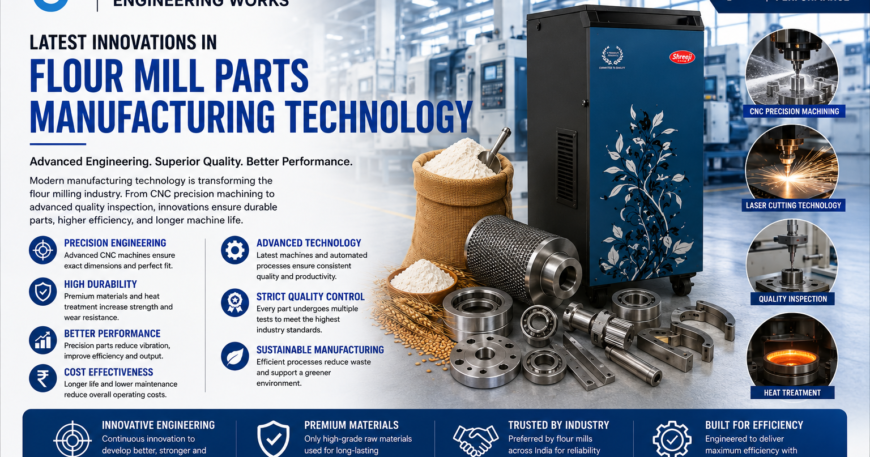
The flour milling industry has evolved significantly over the past decade. Modern flour mills require high-performance machinery capable of producing consistent flour quality while minimizing downtime and maintenance costs. One of the biggest reasons behind this transformation is the advancement in flour mill parts manufacturing technology.
Today, manufacturers are using cutting-edge production techniques such as CNC machining, laser cutting, CAD/CAM design, robotic manufacturing, precision engineering, and advanced quality testing to produce highly durable and accurate flour mill spare parts.
Unlike traditional manufacturing methods, modern engineering ensures every component meets strict quality standards, resulting in better machine performance, improved production efficiency, and longer equipment life.
Whether you own a commercial flour mill or operate an industrial milling plant, understanding these innovations will help you invest in better spare parts and improve your overall productivity.
Why Manufacturing Technology Matters in Flour Mill Parts
Every flour mill consists of numerous mechanical components working together continuously for long hours.
These include:
- Flour Mill Drum
- Blade Cutter
- Ring
- Liner Cutter
- Jali
- Bearings
- Shafts
- Pulleys
- Rollers
- Grinding Components
- Couplings
- Door Lock Knob
If even one component is poorly manufactured, it can reduce machine efficiency and increase operating costs.
Modern manufacturing technology ensures these parts are:
- Stronger
- More precise
- More durable
- Better balanced
- Wear-resistant
- Long-lasting
This directly improves milling performance and reduces production interruptions.
Evolution of Flour Mill Parts Manufacturing
Traditional Manufacturing
Earlier, flour mill parts were manufactured using manual machining processes.
Common issues included:
- Inconsistent dimensions
- Poor surface finish
- Higher production errors
- Shorter component life
- Low production capacity
Manual production depended heavily on operator skills, resulting in inconsistent quality.
Modern Manufacturing
Today’s manufacturers use advanced engineering technologies to produce accurate and reliable components.
Modern production involves:
- CNC Turning
- CNC Milling
- Laser Cutting
- CAD Design
- CAM Programming
- Heat Treatment
- Precision Grinding
- Surface Finishing
- Digital Inspection
These technologies have completely changed the flour mill industry.
CNC Machining – The Backbone of Modern Manufacturing
One of the biggest innovations is CNC (Computer Numerical Control) machining.
Instead of manual operation, computers precisely control every cutting tool.
Benefits include:
- Micron-level accuracy
- Perfect dimensions
- Smooth surface finish
- Faster production
- Better repeatability
- Reduced material wastage
CNC-machined flour mill spare parts fit perfectly into machines, reducing unnecessary wear and vibration.
CAD and CAM Technology
Modern manufacturers first design every spare part using CAD (Computer-Aided Design) software.
The digital model allows engineers to:
- Check dimensions
- Analyze strength
- Improve design
- Reduce manufacturing errors
After approval, CAM software converts the design into machine instructions for CNC production.
This process ensures every part is identical to the original design.
Advanced Raw Materials
Material quality is equally important.
Today’s premium flour mill parts are manufactured using:
Alloy Steel
Offers excellent strength and durability.
Carbon Steel
Suitable for high-load applications.
Stainless Steel
Provides corrosion resistance.
Hardened Steel
Ideal for wear-prone components.
Special Heat-Treated Materials
Increase hardness and improve service life.
Using superior raw materials significantly increases machine reliability.
Heat Treatment Technology
Heat treatment is one of the most important manufacturing processes.
It improves:
- Hardness
- Strength
- Wear resistance
- Fatigue resistance
- Load-bearing capacity
Common heat treatment methods include:
- Hardening
- Tempering
- Annealing
- Case Hardening
Proper heat treatment ensures flour mill spare parts last much longer under continuous operation.
Precision Engineering
Precision engineering ensures every component fits perfectly.
Benefits include:
- Lower vibration
- Better balance
- Smooth rotation
- Reduced friction
- Higher efficiency
Even a small dimensional error can reduce milling performance.
Modern precision engineering eliminates these problems.
Surface Finishing Technology
Surface finishing enhances both appearance and performance.
Modern finishing techniques include:
- Grinding
- Polishing
- Sand Blasting
- Powder Coating
- Electroplating
These treatments reduce corrosion, improve wear resistance, and increase product life.
Quality Inspection and Testing
Leading manufacturers inspect every component before dispatch.
Common quality tests include:
Dimensional Inspection
Checks size accuracy.
Hardness Testing
Measures material strength.
Surface Finish Inspection
Ensures smooth operation.
Balance Testing
Reduces machine vibration.
Material Testing
Confirms raw material quality.
Quality testing guarantees consistent performance.
Automation in Manufacturing
Automation has transformed industrial production.
Modern factories now use:
- Automatic CNC Machines
- Robotic Material Handling
- Automated Inspection Systems
- Digital Measuring Equipment
Advantages include:
- Faster production
- Better consistency
- Lower manufacturing errors
- Reduced labor dependency
Automation also helps manufacturers meet large customer demands efficiently.
Benefits of Advanced Manufacturing Technology
Higher Machine Efficiency
Precision parts improve operational performance.
Reduced Downtime
Reliable components prevent unexpected failures.
Lower Maintenance Cost
Quality parts require fewer replacements.
Better Flour Quality
Uniform grinding produces consistent flour.
Longer Machine Life
Accurate fitting reduces stress on machinery.
Energy Savings
Efficient components reduce power consumption.
Latest Innovations in Flour Mill Components
Modern flour mill spare parts now include:
- Precision-balanced drums
- Wear-resistant blade cutters
- High-strength liner cutters
- Precision-engineered rings
- Durable jali systems
- Advanced bearings
- High-performance shafts
These innovations provide better productivity and lower operating costs.
Environmental Benefits
Modern manufacturing also supports sustainability.
Advantages include:
- Reduced material waste
- Lower energy consumption
- Efficient machining
- Longer component life
- Less replacement waste
These practices help industries reduce environmental impact.
How to Choose a Modern Flour Mill Parts Manufacturer
When selecting a manufacturer, consider:
Manufacturing Technology
Choose companies using CNC and modern machinery.
Material Quality
Ensure premium-grade raw materials.
Industry Experience
Experienced manufacturers understand milling challenges.
Quality Control
Look for strict inspection procedures.
Custom Manufacturing
The ability to produce customized parts is an added advantage.
Customer Support
Reliable after-sales support is essential.
Why Choose Gurudev Engineering?
At Gurudev Engineering, we combine advanced manufacturing technology with years of industry expertise to deliver precision-engineered flour mill spare parts.
Our manufacturing strengths include:
- Advanced CNC machining
- Premium raw materials
- Strict quality inspection
- Precision engineering
- Reliable product performance
- Competitive pricing
- Timely delivery
We manufacture high-quality components designed to improve milling efficiency, reduce maintenance costs, and extend machine life.
Our commitment to innovation ensures every product meets the highest industry standards.
Future of Flour Mill Parts Manufacturing
The future of manufacturing is becoming smarter every year.
Emerging technologies include:
- Artificial Intelligence (AI) for quality inspection
- IoT-enabled smart monitoring
- Predictive maintenance systems
- Robotics in production
- Automated material handling
- 3D design simulation
- Digital manufacturing systems
These advancements will make flour mill machinery even more efficient, reliable, and cost-effective.
Conclusion
Modern flour mill parts manufacturing technology has transformed the milling industry by improving precision, durability, and overall machine performance. Innovations such as CNC machining, CAD/CAM design, heat treatment, precision engineering, automation, and advanced quality testing ensure that every component delivers reliable and long-lasting performance.
Choosing a trusted manufacturer that invests in these technologies helps flour mill owners reduce downtime, lower maintenance costs, improve flour quality, and maximize productivity. As manufacturing technology continues to evolve, businesses that adopt high-quality, precision-engineered spare parts will remain more competitive and efficient in the long run.