
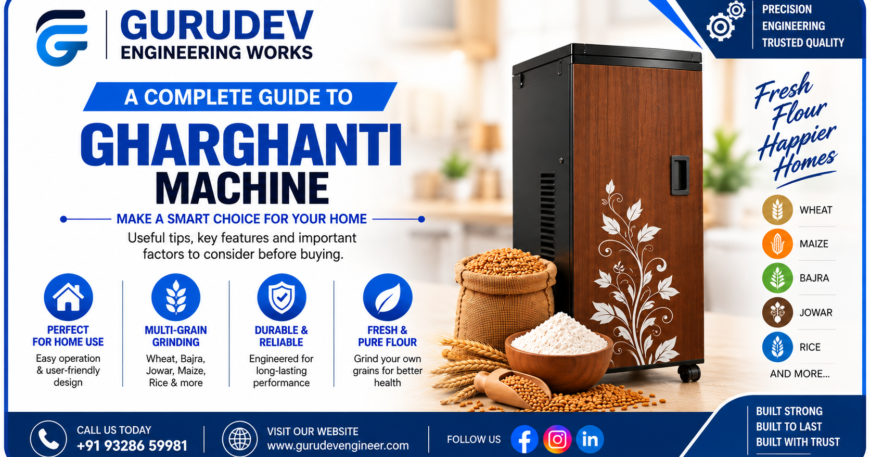
A gharghanti machine is becoming a popular choice for Indian households that want the convenience of grinding wheat and other grains at home. A domestic flour mill can save time, provide flexibility, and make everyday flour grinding more convenient.
However, buying a gharghanti should not be based only on its price or motor power.
Different machines can have different designs, capacities, grinding systems, construction qualities, and features. A machine that is suitable for one family may not be the right choice for another.
Before purchasing a home atta chakki, it is important to understand what you are actually getting.
In this guide, we explain 10 important things to check before buying a gharghanti machine.
1. Check the Motor Power
The motor is one of the most important components of a domestic flour mill.
Motor power is generally specified in HP. Different machines are available with different motor capacities depending on their intended application.
But there is one important point:
Higher HP does not automatically mean a better gharghanti.
The motor should work efficiently with the complete machine design.
When comparing machines, consider:
- Motor capacity
- Electrical requirements
- Expected usage
- Grinding requirements
- Recommended operating time
- Machine capacity
For a small household, a compact machine may be sufficient. Families with higher grinding requirements may need a different configuration.
Always ask the manufacturer about the recommended application instead of choosing only by HP.
2. Check the Grinding Capacity
Capacity is another important factor.
Before buying a gharghanti machine, think about how much flour your family normally needs.
For example, a small family that grinds flour occasionally may not need a high-capacity machine.
A larger household that grinds grain frequently may prefer a machine designed for greater usage.
Capacity can depend on:
- Motor power
- Grain type
- Grain condition
- Grinding settings
- Machine design
- Operating method
Do not compare capacity figures from different manufacturers without checking how those figures are measured.
3. Understand the Grinding System
The grinding system is the heart of a flour mill.
It determines how the grain is processed inside the machine.
Before purchasing, ask the manufacturer:
- What type of grinding system is used?
- Which grains are supported?
- How is the grinding fineness adjusted?
- What components are used?
- How are replacement components supplied?
A good grinding system should be suitable for the intended application.
If you want to grind multiple grains, make sure the machine is designed for those materials.
4. Check Which Grains the Machine Can Grind
Not every domestic flour mill is designed for exactly the same applications.
Depending on the machine, suitable grains may include:
- Wheat
- Bajra
- Jowar
- Maize
- Corn
- Rice
- Other suitable grains
If you regularly use different grains, confirm compatibility before buying.
This is particularly important because different grains can have different hardness, moisture, and grinding characteristics.
Never assume that every gharghanti can grind every grain.
Always check the manufacturer’s specifications.
5. Look at Machine Construction
The machine’s external body is more than just a design feature.
The cabinet protects internal components and contributes to the machine’s overall appearance and usability.
When comparing a domestic flour mill, check:
Body Material
Ask about the material used for the cabinet.
Structural Strength
Check whether the machine feels stable during operation.
Door Construction
The door should be properly fitted and easy to operate.
Finishing
Good finishing can improve appearance and make routine cleaning easier.
Ventilation
Proper ventilation is important for machines containing electrical and mechanical components.
A well-designed cabinet can provide a better overall user experience.
6. Check the Machine Size
Space is an important consideration for a home flour mill.
Before ordering, measure the area where you plan to keep the machine.
Check:
- Height
- Width
- Depth
- Operating space
- Door opening
- Ventilation space
A machine may look compact in photographs but require more room once installed.
Therefore, always check the actual dimensions.
Also make sure the machine can be comfortably accessed for cleaning and operation.
7. Check the Noise and Vibration
Noise and vibration can affect the experience of using a flour mill at home.
Several factors can influence these characteristics, including:
- Motor design
- Machine construction
- Component balance
- Installation
- Alignment
- Operating conditions
If possible, see the machine running before making a purchase.
Pay attention to whether the machine remains stable during operation.
Unusual vibration or mechanical noise should not be considered normal without investigation.
8. Look for Safety Features
Since a gharghanti uses an electric motor and moving mechanical components, safety should be an important part of your buying decision.
Depending on the machine, safety features may include:
- Proper electrical protection
- Secure doors
- Motor protection
- Overload protection
- Safe control switches
Ask the manufacturer what safety features are included in the specific model.
Also follow the operating instructions provided with the machine.
Never operate or clean internal components while the machine is connected to power.
9. Check Cleaning and Maintenance Requirements
A home flour mill should be reasonably easy to maintain.
Flour particles can accumulate during regular operation, so routine cleaning is important.
Before buying, ask:
- How should the machine be cleaned?
- Which areas require regular cleaning?
- Can the grinding chamber be accessed safely?
- What maintenance is recommended?
- Which parts may require periodic replacement?
A machine that is easy to clean can be more convenient for regular household use.
Avoid using excessive water around electrical components unless specifically permitted by the manufacturer.
10. Check Spare Parts and After-Sales Support
This is one of the most important things many buyers overlook.
A gharghanti is a machine with mechanical and electrical components. Over time, some parts may naturally require inspection or replacement.
Before buying, ask the manufacturer about the availability of:
- Grinding components
- Bearings
- Belts
- Shafts
- Cutters
- Jali
- Other replacement components
Also check whether the manufacturer provides technical assistance or service support.
A manufacturer who can support the machine after purchase can make long-term ownership much easier.
Bonus: Don’t Forget the Warranty
Warranty terms can vary between manufacturers and models.
Before purchasing, understand:
- Warranty duration
- What components are covered
- What is not covered
- Service procedure
- Replacement conditions
Do not assume that every part of the machine has the same warranty coverage.
Ask for the warranty terms clearly before placing the order.
Common Mistakes to Avoid
Choosing Only by Price
The cheapest machine may not always provide the features or construction you require.
Choosing Only by HP
Motor power is important, but the complete machine design matters too.
Ignoring Dimensions
Always measure your available space before ordering.
Not Asking About Grain Compatibility
Confirm which grains the machine is designed to process.
Ignoring Spare Parts
Ask about replacement components before purchasing.
Not Checking the Warranty
Understand the warranty terms instead of making assumptions.
How to Compare Two Gharghanti Machines
Suppose you are comparing two machines.
Instead of simply asking:
“Which one is cheaper?”
Compare:
Motor + Capacity + Grinding System + Construction + Features + Safety + Warranty + Service
This gives you a much clearer picture of the actual value.
A slightly higher initial investment can sometimes provide better long-term value if the machine offers suitable construction, support, and features.
Why Choose a Reliable Gharghanti Manufacturer?
The manufacturer plays an important role in the overall buying experience.
An experienced manufacturer can help you understand:
- Machine specifications
- Grinding capacity
- Suitable grains
- Maintenance requirements
- Spare parts
- Technical support
It is especially useful when you have specific requirements for your home or want a particular machine configuration.
Why Choose Gurudev Engineering Works?
Gurudev Engineering Works focuses on engineering and manufacturing solutions for flour milling applications.
Our approach emphasizes:
- Quality manufacturing
- Precision components
- Reliable construction
- Practical machine design
- Consistent performance
When choosing a gharghanti, we believe customers should have clear information about the machine and its applications before making a decision.
Is a Gharghanti Worth Buying for Home?
For households that regularly consume wheat flour, a domestic flour mill can be a convenient addition to the kitchen.
The main advantage is flexibility.
You can keep suitable grains at home and grind them according to your requirements.
However, the machine should be selected according to actual household usage.
If you only need small quantities occasionally, a compact model may be enough.
If your household has higher grinding requirements, a higher-capacity model may be more suitable.