
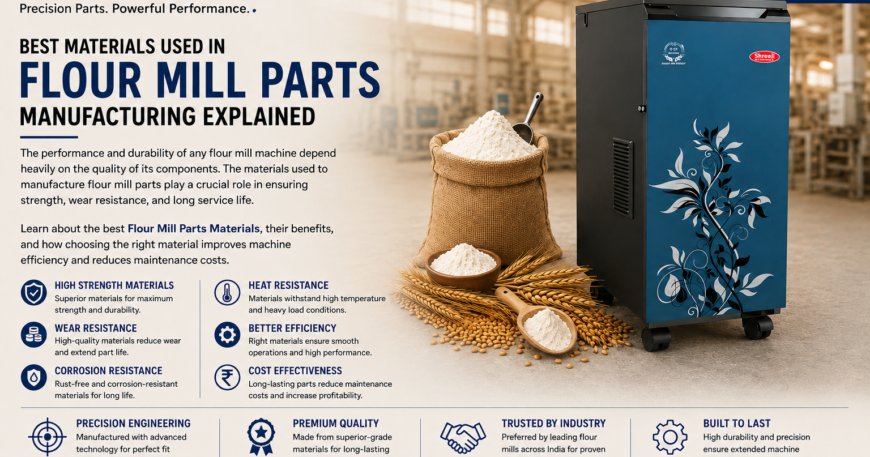
The performance and durability of any flour mill machine depend heavily on the quality of its components. While precision manufacturing and machine design are essential, the materials used to manufacture flour mill parts play an equally important role. Choosing the right material ensures better wear resistance, longer service life, reduced maintenance costs, and improved production efficiency.
Modern flour mills operate continuously under heavy loads, friction, vibration, and varying temperatures. Because of these demanding conditions, manufacturers must use high-grade metals that can withstand harsh industrial environments without compromising performance.
At Gurudev Engineering, we manufacture premium-quality flour mill parts using carefully selected raw materials that meet industry standards for strength, durability, and precision.
In this guide, we’ll explain the most commonly used flour mill parts materials, their advantages, and how selecting the right material helps maximize machine performance and long-term reliability.
Why Material Selection Matters in Flour Mill Parts
Every component inside a flour mill experiences continuous movement and mechanical stress. If the material is weak or unsuitable, it can wear out quickly, leading to machine downtime, expensive repairs, and inconsistent flour quality.
Using premium materials provides several advantages:
- Higher mechanical strength
- Better wear resistance
- Corrosion protection
- Longer machine life
- Lower maintenance costs
- Improved production efficiency
- Consistent grinding performance
Material quality directly impacts the overall productivity and profitability of a flour mill.
Common Materials Used in Flour Mill Parts Manufacturing
Different machine components require different material properties. Below are the most commonly used materials in the flour milling industry.
1. Mild Steel (MS)
Mild Steel is one of the most widely used materials in flour mill parts manufacturing due to its affordability, excellent machinability, and structural strength.
Advantages
- Cost-effective
- Easy to machine
- Good welding properties
- High strength
- Suitable for heavy-duty applications
Applications
- Machine frames
- Support structures
- Door Lock Knobs
- Base plates
- Mounting brackets
For many non-wear components, mild steel offers an excellent balance between strength and cost.
2. Stainless Steel (SS)
Stainless Steel is preferred for components exposed to moisture, food products, and corrosive environments. Its hygienic properties make it ideal for food processing equipment.
Benefits
- Excellent corrosion resistance
- Rust-free performance
- Long service life
- Attractive surface finish
- Easy cleaning and maintenance
Common Applications
- Flour contact components
- Jali
- Food-grade machine parts
- Covers
- Processing equipment
Stainless steel is especially important where food safety and cleanliness are critical.
3. Alloy Steel
Alloy Steel combines carbon steel with additional alloying elements such as chromium, nickel, or molybdenum to enhance strength and wear resistance.
Benefits
- Higher hardness
- Better fatigue resistance
- Excellent load capacity
- Longer operational life
- Superior impact resistance
Applications
- Shafts
- Rollers
- Rings
- Heavy-duty machine components
Alloy steel is ideal for parts operating under extreme stress.
4. Hardened Steel
Certain flour mill components experience constant friction during operation. Hardened steel undergoes heat treatment to improve hardness and wear resistance.
Advantages
- Exceptional durability
- Reduced wear
- Longer replacement intervals
- Better dimensional stability
- Excellent abrasion resistance
Applications
- Blade Cutters
- Liner Cutters
- Cutting Components
- Grinding Parts
This material significantly extends the lifespan of high-wear parts.
5. Cast Iron
Cast Iron remains a popular choice for heavy machine components because of its excellent vibration damping and compressive strength.
Advantages
- High rigidity
- Stable performance
- Excellent vibration absorption
- Long operational life
Applications
- Machine housings
- Structural supports
- Base assemblies
Its stability helps improve overall machine performance.
6. Carbon Steel
Carbon Steel offers excellent mechanical strength while remaining economical.
Benefits
- High tensile strength
- Good durability
- Easy fabrication
- Reliable performance
Applications
- Bearings
- Bushes
- Rollers
- Structural machine components
Heat Treatment Improves Material Performance
Selecting premium material is only part of the manufacturing process. Heat treatment further improves material properties.
Heat treatment increases:
- Hardness
- Wear resistance
- Strength
- Toughness
- Fatigue resistance
This process helps components withstand continuous industrial operation.
Surface Finishing for Longer Life
Premium flour mill parts also undergo surface finishing to improve durability.
Popular finishing methods include:
- Grinding
- Polishing
- Buffing
- CNC Finishing
- Anti-rust coating
A smooth surface reduces friction, improves appearance, and extends service life.
Importance of CNC Machining
Even the highest-quality material performs poorly if machining accuracy is low.
Advanced CNC machining ensures:
- Accurate dimensions
- Perfect fitting
- Smooth operation
- Reduced vibration
- Better production efficiency
At Gurudev Engineering, every component is manufactured using precision engineering techniques to deliver consistent quality.
How Premium Materials Reduce Maintenance Costs
Using low-grade materials often results in:
- Frequent repairs
- Increased downtime
- Higher electricity consumption
- Poor machine performance
Premium materials reduce maintenance by offering:
- Longer replacement intervals
- Reliable operation
- Better wear resistance
- Lower repair costs
Although premium materials may cost slightly more initially, they provide significant long-term savings.
Flour Mill Parts Manufactured Using Premium Materials
At Gurudev Engineering, we manufacture a wide range of precision-engineered components, including:
- Flour Mill Drum
- Blade Cutter
- Ring
- Jali
- Liner Cutter
- Door Lock Knob
- Varam
- Shafts
- Rollers
- Custom Flour Mill Parts
Each product is manufactured using carefully selected raw materials based on its application and operating conditions.
How to Choose the Right Material
Before purchasing flour mill parts, consider the following:
Machine Type
Different machines require different materials.
Operating Environment
Moisture, dust, and temperature influence material selection.
Load Capacity
Heavy-duty operations require stronger materials.
Wear Conditions
High-friction components should use hardened or alloy steel.
Budget
Balance initial investment with long-term durability.
Maintenance Requirements
Premium materials reduce maintenance frequency and machine downtime.
Why Choose Gurudev Engineering?
At Gurudev Engineering, quality begins with selecting the right raw materials. Every component is manufactured under strict quality standards to ensure maximum reliability.
Why customers trust us:
- Premium-grade raw materials
- Advanced CNC machining
- Precision engineering
- Strict quality inspection
- Customized manufacturing solutions
- Competitive pricing
- Timely delivery across India
- Experienced engineering team
Our commitment to quality ensures that every flour mill part delivers exceptional performance and long service life.
Conclusion
The success of any flour mill depends on the quality of its machine components. Selecting the right Flour Mill Parts Materials improves durability, efficiency, and overall machine performance. Materials such as mild steel, stainless steel, alloy steel, hardened steel, cast iron, and carbon steel each offer unique advantages for different applications.
Investing in premium-quality materials not only reduces maintenance costs but also increases productivity and extends equipment life.
If you’re looking for reliable, precision-engineered flour mill parts manufactured using the best materials, Gurudev Engineering is your trusted partner for quality, durability, and performance.