
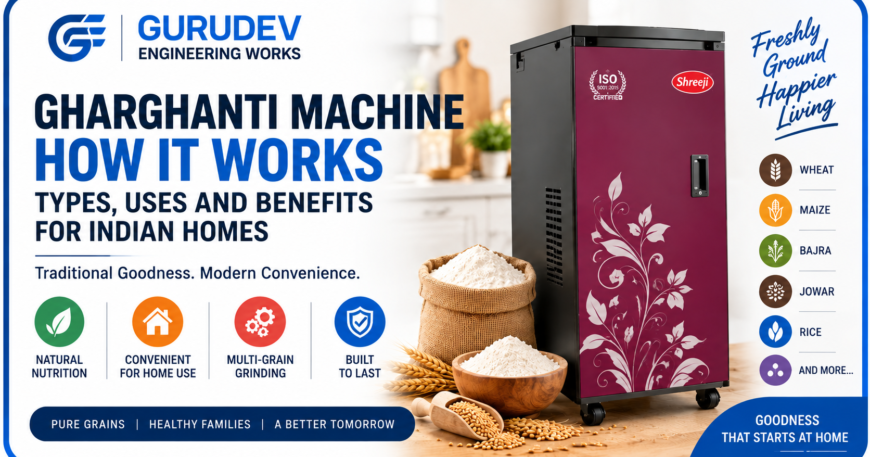
A gharghanti machine is a popular solution for families that prefer grinding flour at home.
The basic idea is simple: grain is fed into the machine, the grinding mechanism processes it, and the finished flour is collected for household use.
Modern atta chakki machines have developed considerably. Today’s machines can feature compact cabinets, electric motors, improved grinding systems, automatic controls, and convenient flour collection arrangements.
But how exactly does a gharghanti work?
What are the different types?
And what should you know before purchasing one?
Let’s understand everything step by step.
What Is Gharghanti?
Gharghanti is the commonly used Indian term for a household flour mill or atta chakki.
It is primarily designed to grind grains into flour at home.
The machine can be useful for households that regularly consume wheat flour and want the convenience of grinding their own grain.
Depending on the model, the machine may support different grains and grinding requirements.
How Does a Gharghanti Machine Work?
The basic working process can be explained in a few simple steps.
Step 1: Grain Is Added
Clean grain is placed into the machine’s grain feeding area.
Step 2: Grain Moves Toward the Grinding Chamber
The machine guides the grain toward the grinding mechanism.
Step 3: Grinding Takes Place
The motor drives the grinding components.
The grain is processed according to the machine’s grinding arrangement and adjustment.
Step 4: Flour Is Produced
The processed material moves through the appropriate outlet or sieving arrangement.
Step 5: Flour Is Collected
The finished flour is collected in the designated container.
The exact process varies according to the design of the machine.
Main Components of a Gharghanti
A domestic flour mill contains several important components.
These may include:
- Electric motor
- Grinding chamber
- Grinding components
- Hopper
- Sieving system
- Flour outlet
- Control panel
- Cabinet
- Bearings
- Shaft
- Belts or drive components
Each component has a specific role in the machine’s operation.
Types of Gharghanti Machines
Different households can have different requirements.
Therefore, manufacturers offer various machine configurations.
Single Chamber Gharghanti
A single chamber design is generally intended for straightforward household grinding applications.
It can be a practical option for users looking for a simple domestic flour mill.
Double Chamber Gharghanti
A double chamber design uses two chambers or a different internal arrangement depending on the machine configuration.
It may be preferred for certain grinding requirements.
The exact benefits depend on the manufacturer’s design.
Automatic Gharghanti
Automatic flour mill machines are designed to simplify operation.
Depending on the model, automation can help control parts of the grinding process and improve user convenience.
Gharghanti vs Traditional Grinding
Traditional grinding methods require more manual effort and time.
A modern gharghanti provides an electric-powered alternative.
Traditional Grinding
- More manual effort
- Time-consuming
- Limited convenience
- Requires external grinding equipment in many cases
Modern Gharghanti
- Electric operation
- Convenient for home use
- Faster household grinding
- Compact design
- Easy operation
This makes domestic flour mills attractive for modern households.
Benefits of Using a Gharghanti at Home
1. Convenient Flour Grinding
You can grind flour according to your household requirements.
2. Flexible Grain Selection
Depending on the model, different grains can be processed.
3. Home-Based Operation
There is no need to regularly take grain to an outside grinding service.
4. Fresh Grinding
You can grind the quantity you require when needed.
5. Easy Operation
Modern machines are designed to make operation simple.
6. Space-Saving Designs
Many domestic flour mills are designed specifically for home environments.
Gharghanti for Different Family Sizes
The right machine can vary depending on household requirements.
Small Family
A compact machine with moderate capacity may be sufficient.
Medium Family
A machine with greater capacity may be more suitable for regular grinding.
Large Family
Higher-capacity domestic or semi-commercial configurations may be considered depending on usage.
Instead of choosing purely based on family size, consider actual monthly grain consumption.
What Can You Grind in a Gharghanti?
Depending on the machine, suitable grains may include:
- Wheat
- Bajra
- Jowar
- Rice
- Maize
- Corn
Some machines may support additional materials.
However, always confirm compatibility with the manufacturer.
Using unsuitable materials can affect machine performance or cause unnecessary wear.
Important Features to Look For
When purchasing a home atta chakki, consider these features:
Strong Motor
The motor should be suitable for the intended workload.
Reliable Grinding System
The grinding mechanism should match your requirements.
Good Construction
The cabinet and internal components should be properly manufactured.
Easy Controls
Simple controls make daily operation more convenient.
Safety Features
Appropriate electrical and mechanical safety features are important.
Easy Maintenance
A practical design can make cleaning and routine maintenance easier.
How Much Flour Can a Gharghanti Produce?
Production depends on several factors.
These include:
- Motor power
- Machine design
- Grain type
- Grain condition
- Grinding setting
- Operating method
Therefore, production capacity should always be checked according to the manufacturer’s specifications.
Do not compare two machines only by motor HP.
How to Get Better Results From Your Gharghanti
Good machine operation starts with proper grain preparation.
Clean the Grain
Remove stones, metal pieces, and unwanted materials before grinding.
Keep the Machine Clean
Regular cleaning helps maintain hygienic operation.
Follow the Recommended Settings
Use the manufacturer’s recommended grinding adjustments.
Avoid Overloading
Feed the machine according to its designed capacity.
Inspect the Machine Regularly
Check for unusual noise, vibration, or other changes in operation.
Common Problems in Gharghanti Machines
Like any mechanical appliance, a gharghanti may develop problems over time.
Some common signs include:
- Excessive noise
- Increased vibration
- Reduced output
- Motor heating
- Uneven grinding
- Difficulty starting
- Unusual sounds
If any unusual condition appears, stop the machine and inspect it according to the manufacturer’s instructions.
Why Machine Design Matters
Two machines may have similar motor ratings but provide different user experiences.
Why?
Because performance depends on the complete system.
Important factors include:
Motor + Grinding System + Mechanical Design + Component Quality + Machine Balance + Proper Operation
This is why choosing a machine only by HP or price can be misleading.
Choosing a Gharghanti Manufacturer
Before buying a domestic flour mill, research the manufacturer.
Look for:
- Manufacturing experience
- Product specifications
- Quality control
- Machine construction
- Available service
- Spare-part availability
- Customer support
A manufacturer that understands flour milling applications can provide better technical guidance.
Why Gurudev Engineering?
Gurudev Engineering Works focuses on precision engineering and manufacturing for flour milling applications.
Our approach combines:
- Quality manufacturing
- Precision components
- Practical machine design
- Reliable performance
- Engineering expertise
For a household flour mill, these factors are important because the machine should be convenient, reliable, and suitable for regular use.
The Future of Gharghanti Machines
The domestic flour mill market is moving toward more convenient and user-friendly machines.
Future developments may focus on:
- Better automation
- Improved motor efficiency
- Smarter controls
- Compact designs
- Easier cleaning
- Better noise management
- Improved safety systems
As technology develops, home flour mills can become even more convenient for Indian households.
Conclusion
A gharghanti machine is more than just a grain grinding appliance. It is a compact home milling solution designed to make flour preparation more convenient.
Understanding how the machine works, which types are available, what grains it can process, and which features matter can help you make a better purchasing decision.
Whether you are looking for a home atta chakki, domestic flour mill, or wheat flour mill machine, always compare the complete specifications rather than focusing only on price or motor power.
A properly selected machine can provide convenient and reliable flour grinding for everyday household requirements.