
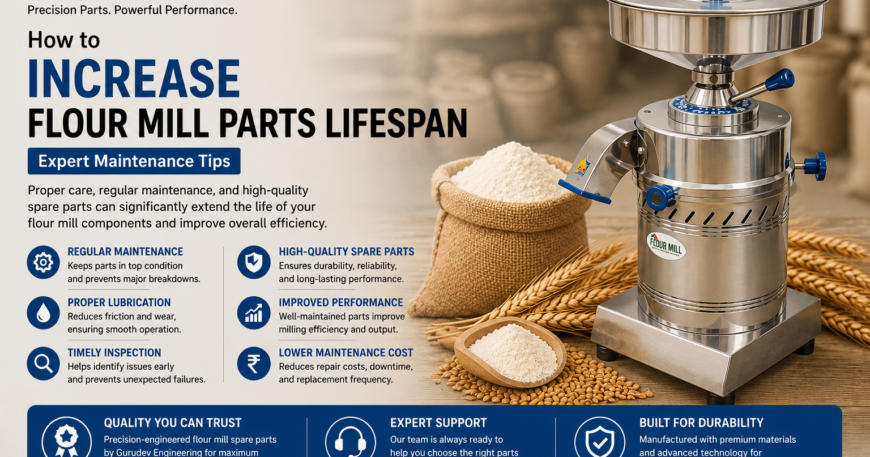
Every flour mill owner aims to maximize machine performance while minimizing maintenance costs. One of the most effective ways to achieve this is by extending the lifespan of flour mill parts. Components such as grinding rollers, beaters, blades, screens, liners, hammers, and shafts are subjected to continuous wear during operation. Without proper maintenance, these essential parts can wear out quickly, resulting in costly repairs and production downtime.
At Gurudev Engineering, we manufacture premium-quality flour mill spare parts designed for durability and precision. However, even the highest-quality components require regular maintenance to perform efficiently over the long term.
This guide shares expert maintenance practices that help extend the service life of your flour mill machinery.
Why Maintenance Matters
Proper maintenance provides several benefits:
- Reduces unexpected machine breakdowns
- Improves milling efficiency
- Lowers repair expenses
- Extends equipment lifespan
- Maintains consistent flour quality
- Minimizes production downtime
- Enhances operator safety
Regular maintenance is always more affordable than replacing damaged machine parts.
Inspect Parts Regularly
Routine inspections help detect wear before it becomes a major issue.
Check components including:
- Flour mill blades
- Grinding rollers
- Sieves
- Hammer beaters
- Bearings
- Shafts
- Couplings
- Pulley systems
Look for:
- Cracks
- Uneven wear
- Rust
- Loose bolts
- Excessive vibration
Weekly inspections can prevent expensive failures.
Keep Machines Clean
Dust and flour accumulation create heat and friction.
Daily cleaning should include:
- Removing flour deposits
- Cleaning air vents
- Wiping rotating components
- Cleaning screens
- Removing moisture buildup
A clean machine performs more efficiently and lasts longer.
Lubricate Moving Parts
Proper lubrication minimizes friction.
Lubricate:
- Bearings
- Shafts
- Rollers
- Gear assemblies
- Drive systems
Always use the lubricant recommended by the manufacturer.
Replace Worn Components on Time
Avoid waiting until a part completely fails.
Replace:
- Blades
- Liners
- Screens
- Hammers
- Rollers
Timely replacement protects expensive machine components.
Use Genuine High-Quality Spare Parts
Cheap replacement parts often:
- Wear faster
- Reduce milling accuracy
- Increase maintenance frequency
- Damage nearby components
Premium precision-engineered spare parts provide:
- Better durability
- Higher accuracy
- Improved efficiency
- Longer service life
Avoid Machine Overloading
Running machines beyond capacity causes:
- Bearing failure
- Shaft bending
- Excessive vibration
- Motor overheating
Always follow the recommended production capacity.
Train Machine Operators
Well-trained operators:
- Detect early warning signs
- Follow maintenance schedules
- Avoid improper operation
- Reduce accidental damage
Operator training significantly increases equipment lifespan.
Maintain Proper Alignment
Incorrect alignment causes:
- Belt wear
- Vibration
- Bearing damage
- Increased energy consumption
Periodic alignment checks improve overall machine performance.
Store Spare Parts Correctly
Store replacement parts:
- In dry environments
- Away from moisture
- Protected from dust
- Properly labeled
Proper storage prevents rust and premature deterioration.
Follow Preventive Maintenance Schedule
Create a maintenance calendar.
Daily
- Cleaning
- Visual inspection
Weekly
- Lubrication
- Bolt tightening
Monthly
- Bearing inspection
- Belt alignment
- Motor inspection
Quarterly
- Replace worn components
- Complete machine inspection
Why Choose Gurudev Engineering?
Gurudev Engineering manufactures precision flour mill spare parts using premium raw materials and advanced manufacturing technology.
We offer:
- Precision engineering
- Long-lasting performance
- Excellent dimensional accuracy
- Reliable product quality
- Competitive pricing
- Timely delivery
- Customer support
Our products are trusted by flour mills across India.
Conclusion
Increasing the lifespan of flour mill parts is not difficult when proper maintenance practices are followed. Regular inspections, cleaning, lubrication, correct operation, and high-quality spare parts significantly improve machine reliability while reducing operating costs.