
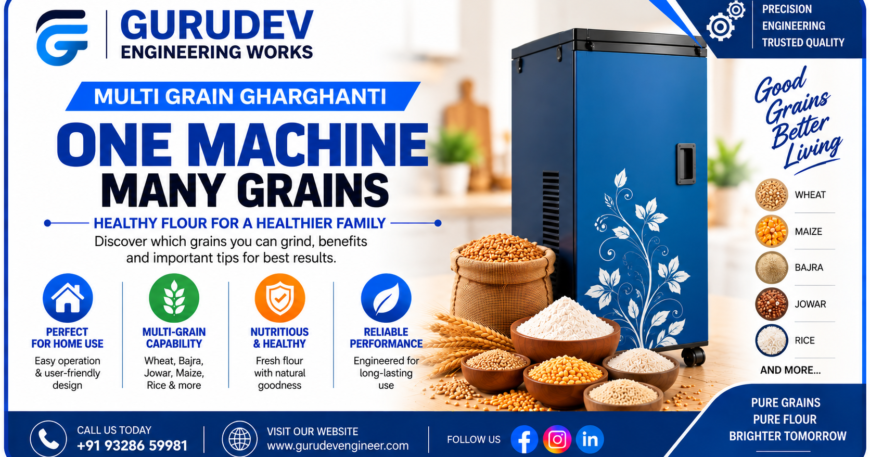
A modern gharghanti machine is not limited to wheat flour. Depending on its design and manufacturer specifications, many domestic flour mills can process different grains for everyday household use.
Wheat remains one of the most commonly processed grains, but Indian households also use grains such as bajra, jowar, maize and rice.
This makes a multi grain gharghanti a practical option for families that want greater flexibility from their home flour mill.
However, every machine is different. Grain hardness, moisture, size and machine design can affect the grinding process.
Therefore, it is important to understand which grains are suitable for your machine and how they should be prepared before grinding.
In this guide, we will look at common grains used in a gharghanti and the important factors that can affect grinding performance.
What Is a Multi Grain Gharghanti?
A multi grain gharghanti is a domestic flour mill designed to process more than one type of grain, depending on the manufacturer’s specifications.
Instead of using the machine only for wheat, users may be able to process suitable grains such as:
- Wheat
- Bajra
- Jowar
- Maize
- Rice
- Corn
The exact capability depends on the grinding mechanism and machine configuration.
Before using a new grain, always check the manufacturer’s recommendations.
1. Wheat
Wheat is the most common grain processed in a domestic flour mill.
It is widely used for preparing:
- Atta
- Roti
- Chapati
- Paratha
- Other flour-based foods
Clean and properly stored wheat can generally be prepared for grinding according to the machine’s instructions.
The condition of the grain can affect the grinding process and the resulting flour.
2. Bajra
Bajra, also known as pearl millet, is another grain commonly used in Indian households.
Bajra is naturally different from wheat in size, texture and grinding characteristics.
If you want to grind bajra in your gharghanti machine, check whether your specific model supports it.
The grain should be cleaned properly before processing.
3. Jowar
Jowar, or sorghum, is another traditional grain used in many parts of India.
It can be used for preparing jowar flour for different recipes.
Because grain characteristics vary, the manufacturer’s recommended settings should be followed when processing jowar.
4. Maize
Maize and corn can also be processed in suitable flour mill machines.
Before grinding maize, make sure it is:
- Clean
- Free from stones
- Free from metal particles
- Properly stored
- Suitable for your machine
Do not put unsuitable or excessively hard materials into a domestic flour mill.
5. Rice
Some multi-grain flour mills are designed to process rice.
Rice can be used for preparing rice flour for different household applications.
However, always verify that your machine is suitable for rice grinding before using it.
Why Grain Preparation Is Important
The condition of the grain can affect the grinding process.
Before putting grain into your home flour mill, remove unwanted materials such as:
- Stones
- Metal pieces
- Dirt
- Large foreign objects
- Damaged or unsuitable material
This simple preparation step helps reduce the risk of unwanted material entering the grinding system.
Grain Moisture Can Affect Grinding
Moisture is another important factor.
Grains with excessive moisture can behave differently during grinding compared with properly stored, dry grain.
Moisture can affect:
- Grinding consistency
- Flour flow
- Machine operation
- Cleaning requirements
Always follow the grain preparation recommendations provided by your machine manufacturer.
Does Every Gharghanti Grind Every Grain?
This is an important point for buyers.
A machine advertised as a flour mill should not automatically be assumed to support every type of grain.
The manufacturer’s specifications should be checked before processing a new material.
Factors that influence grain compatibility include:
- Grinding mechanism
- Motor capacity
- Machine design
- Grain hardness
- Grain size
- Recommended operating conditions
How Multi Grain Grinding Adds Convenience
A multi grain gharghanti can give households greater flexibility.
Instead of purchasing separate machines for different grains, a suitable machine may allow multiple compatible grains to be processed using the same equipment.
This can be useful for families that regularly use different types of flour.
Tips for Better Multi Grain Grinding
Clean the Grain First
Always remove stones, dirt and other unwanted material.
Follow the Correct Settings
Use the recommended machine settings for the particular grain.
Avoid Overloading
Feed grain according to the machine’s recommended operating capacity.
Keep the Machine Clean
Different grains can leave different types of residue.
Regular cleaning helps keep the machine ready for the next grinding session.
Don’t Mix Unknown Materials
Only process grains and materials approved by the manufacturer.
Multi Grain Gharghanti for Indian Homes
Indian food habits vary significantly from region to region.
Some families primarily use wheat.
Others regularly use:
- Bajra
- Jowar
- Maize
- Rice
- Mixed grains
This is one reason multi-grain capability can be an important feature when selecting a domestic flour mill.
Instead of choosing a machine based only on appearance or motor power, consider the grains you actually use at home.
What Makes a Good Multi Grain Flour Mill?
A suitable multi-grain machine should have a grinding system designed for its intended applications.
Important factors include:
Suitable Grinding Mechanism
The mechanism should be appropriate for the supported grains.
Reliable Motor
The motor should match the machine’s intended workload.
Practical Design
The machine should be convenient for regular household use.
Easy Cleaning
A practical cleaning arrangement makes multi-grain use easier.
Replacement Support
Availability of suitable replacement components is useful for long-term ownership.
Why You Should Check Manufacturer Specifications
Different manufacturers may use different designs.
Two machines with similar motor ratings may have different grain compatibility.
Therefore, before trying a new grain, ask the manufacturer:
- Is this grain supported?
- What quantity can be processed?
- Is a particular setting required?
- Are there any special preparation instructions?
- How should the machine be cleaned afterward?
This can help prevent incorrect usage.
Multi Grain Gharghanti and Everyday Convenience
The main advantage of a multi-grain home flour mill is flexibility.
A suitable machine can become useful for households that want to process different grains without purchasing separate equipment.
It also allows users to select grains according to their household requirements.
Why Choose Gurudev Engineering Works?
Gurudev Engineering Works focuses on engineering and manufacturing solutions for flour milling applications.
Our approach emphasizes:
- Precision manufacturing
- Reliable construction
- Quality components
- Practical machine design
- Consistent performance
For a domestic flour mill, understanding the intended application is important.
The right machine should be selected according to the grains you plan to process and your expected household usage.
Conclusion
A multi grain gharghanti can provide greater flexibility for Indian households that use different types of flour.
Wheat, bajra, jowar, maize and rice may be suitable for certain machines, but grain compatibility always depends on the specific machine design.
Before grinding a new grain, check the manufacturer’s specifications, prepare the grain properly and follow the recommended operating instructions.
With the right machine and proper usage, a domestic flour mill can become a convenient solution for processing a variety of suitable grains at home.